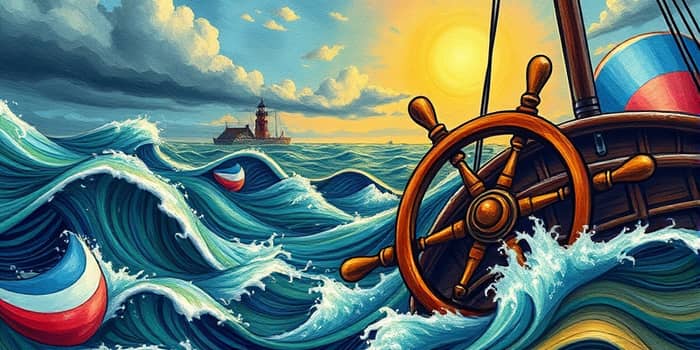
In an era of rapid change and persistent uncertainty, investors and business leaders must become skilled navigators. The global economy resembles a vast, shifting ocean—complete with currents, tides, storms, reefs, and guiding lighthouses. To thrive, you need more than raw conviction: you need a compass, charts, and a clear plan.
Why We Need a Market Navigator Now
Today’s economic seas are defined by mixed signals, diverging forecasts, and unexpected shocks. Geopolitical tensions, rapid technological shifts, and climate events can churn markets without warning. In this highly uncertain environment, reacting to every headline leads to costly mistakes. Instead, we need a navigator’s mindset—anticipating changes, preparing for surprises, and steering steadily toward long‐term goals.
Like mariners of old, modern navigators rely on instruments: macro data, market pricing, yield curves, and scenario analysis. They watch weather patterns—policy shifts, trade tensions, innovation waves—and adjust their route, protecting capital when needed and seizing opportunities when they emerge.
Mapping the Global Economic Seas
The “fog of forecasts” thickens as major institutions disagree on growth paths. Major 2026 growth projections range from 2.4% to 3.2%, underscoring the need for scenario planning and stress testing. Below is a snapshot of forecasts:
This divergence, often exceeding one percentage point, creates two primary scenarios: a “sluggish sea” at 2.4% world growth and a “robust tide” at 3.2%. Navigators should build portfolios and strategies around both, then rebalance as data clears the fog.
Regional Waters
- United States: Resilient growth driven by consumption, fiscal stimulus, and near $500 billion in AI investment.
- Euro area: Shallow but stable waters, with moderate growth, inflation near target, and accommodative policy.
- United Kingdom: Mixed currents—lower inflation but sluggish output and political crosswinds.
- Japan: Slow but steady, driven by automation, wage gains, and BOJ normalization.
- Emerging Markets: Heterogeneous conditions—some buoyant on loose policy, others weighed by debt and currency stresses.
Each region offers unique opportunities and risks. The US lane may reward higher returns but comes with wage pressures and tariff crosscurrents. Europe is safer yet slower, while emerging markets require selective navigation around debt reefs and currency tides.
Market Currents and New Trade Winds
- Equities: Valuations differ sharply between tech and cyclicals.
- Bonds: Yield curves signal potential slowdowns when inverted.
- Currencies: Rate differentials drive capital flows and import costs.
- Commodities: Energy and food prices remain sensitive to supply shocks.
- Innovation Winds: AI, digitalization, and climate transition fuel new momentum.
Understanding these currents helps you position assets. Inverted yield curves may warn of recessionary risks, while AI‐driven sectors can offer growth tailwinds. A diversified approach across assets smooths returns and mitigates single‐point failures.
Hidden Reefs and Storms
Beneath the surface lie structural dangers: high public and private debt, geopolitical flareups, tariff escalations, and stagflation risks in key economies. These hidden reefs can rip a portfolio’s hull. Scenario analysis should test for sudden interest‐rate spikes, energy supply disruptions, and policy missteps.
Stay alert to warning signs: credit spreads widening, political upheaval, rapid currency moves. When storms gather, reduce portfolio duration, tilt toward quality, or increase cash buffers to protect against downside shocks.
Navigation Tools for Today’s Navigator
- Leading economic indicators: PMI, employment data, and yield‐curve shifts.
- Risk frameworks: Value‐at‐risk, stress tests, and capital at risk metrics.
- Hedging instruments: Options, futures, and currency forwards.
- Behavioral guardrails: Predefined rules to counter emotional decisions.
By combining data with disciplined rules, you avoid chasing the latest hot take. Use a systematic review schedule—monthly or quarterly—to update assumptions, rebalance exposures, and recalibrate scenarios.
Charting Your Course
Becoming a Market Navigator is both art and science. It demands a blend of rigorous analysis, creative thinking, and emotional discipline. Develop a clear plan that outlines risk tolerances, asset‐allocation ranges, and decision triggers.
Regularly reassess your assumptions against real‐time data. Document your scenarios, track outcomes, and refine your models. Over time, this systematic approach to investing builds confidence and resilience, enabling you to steer through calm waters and storms alike.
Ultimately, the navigator’s goal is not to predict every swell or tempest—but to remain agile, prepared, and confident. With the right tools, mindset, and strong convictions grounded in data, you can chart a course that transforms uncertainty into opportunity and sails steadily toward your financial destination.
References
- https://www.youtube.com/watch?v=gsEXJvfhj3s
- https://www.mercer.com/en-us/insights/investments/market-outlook-and-trends/economic-and-market-outlook/
- https://www.stgeorgewealth.com/blog/navigator-guiding-you-through-market-waves-chaos-headlines-stay-course
- https://unctad.org/publication/world-economic-situation-and-prospects-2026
- https://www.finveo.com/en/Blog/charting-your-course-using-nautical-techniques-for-forex-analysis/276
- https://www.goldmansachs.com/insights/outlooks/2026-outlooks
- https://www.oxfordeconomics.com/case-study/charting-a-course-for-global-growth-in-the-shipping-industry/
- https://www.spglobal.com/market-intelligence/en/news-insights/research/2026/04/global-economic-outlook-april-2026
- https://nwmaritime.org/all/charting-the-course-quarterly-update-from-maritime-high-school/
- https://www.youtube.com/watch?v=IgKicEIUPuc
- https://www.tradenavigator.com
- https://www.vistage.com/research-center/business-financials/economic-trends/20251027-economic-trends-for-2026-and-beyond/
- https://www.morganstanley.com/Themes/outlooks
- https://www.london.edu/think/2026-trends-for-business