
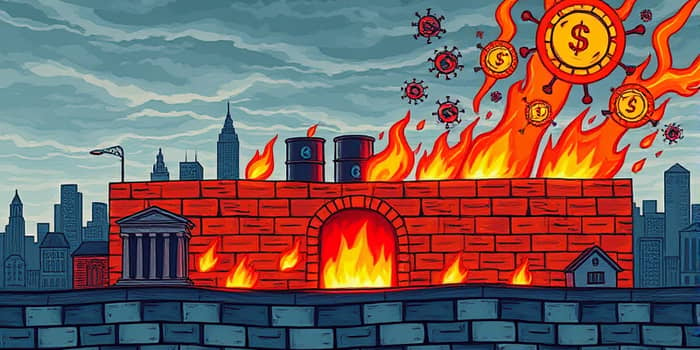
In an era marked by uncertainty, economies face sudden jolts that can derail progress and threaten livelihoods. Whether sparked by geopolitical tension, pandemic outbreaks, or rapid shifts in commodity prices, these shocks test the resilience of systems large and small.
Understanding how to build a robust defense against such disruptions is essential for households, firms, and policymakers alike. By forging strong barriers at every level, we can ensure that localized disturbances remain contained and do not cascade into systemic crises.
Conceptual Foundation: Shocks and Walls
Economic shocks are unexpected large-scale disruptions to economy that can derail markets and livelihoods. They often arrive without warning, fueled by external factors such as geopolitical conflicts, pandemics, or sudden commodity price shifts. In this landscape, financial shocks serve as the mechanism by which economic sparks ignite broader crises, spreading through leverage, liquidity mismatches, and interconnected balance sheets.
The notion of a financial firewall captures the essence of a defense system. It is the layered system of personal, institutional, and policy-level protections designed to absorb and contain economic shocks before they become systemic crises. By erecting barriers at multiple levels, from household budgets to central bank operations, a financial firewall ensures that localized disturbances do not cascade into lasting damage.
Types and Sources of Economic Shocks
Shocks can originate from diverse realms of the economy and beyond:
- Financial crises and credit shocks: sudden lending freezes and bank runs that choke off capital flows.
- Real-economy and commodity shocks: abrupt spikes in oil or food prices that raise production costs and squeeze consumers.
- Pandemic and disaster-linked shocks: lockdowns and supply chain breaks triggered by health emergencies or natural events.
- Political and geopolitical shocks: government instability, wars, and policy gridlock causing fiscal and confidence crises.
- Cyber and technological shocks: large-scale cyberattacks or system failures disrupting payments and market infrastructure.
Each category carries unique transmission channels and magnitudes, but all share the potential to threaten financial stability when left unchecked.
System-Level Firewalls: Regulation and Monetary Policy
In the wake of the 2008 global financial crisis, regulators and policymakers launched an unprecedented effort to fortify the financial system. Central banks, supervisory bodies, and international institutions collaborated to erect robust firewalls, including higher capital requirements, rigorous stress testing, and enhanced resolution mechanisms.
Central banks assumed the role of emergency responders, deploying ensure abundant liquidity and favorable access to credit through asset purchase programs and emergency lending facilities. A notable example is the European Central Bank’s response to COVID-19, which saw its balance sheet swell by over €1.6 trillion in four months, matching four years of previous interventions.
These coordinated firewalls have created a more resilient global financial system, one that can withstand shocks without collapsing into full-blown crises. Yet, they require ongoing vigilance and adaptation as new risks arise in an evolving economic landscape.
Building Your Personal Financial Firewall
While system-level protections are vital, individuals also play a critical role in protecting themselves against economic shocks. By adopting prudent financial habits and planning strategies, households can forge their own resilient defenses.
- Establish rainy day emergency savings for resilience to cover at least three to six months of essential expenses.
- Develop diversified streams of stable income sources such as part-time work, investments, or freelance projects.
- Maintain appropriate insurance coverage—health, property, and income protection—to transfer potential losses.
- Engage in proactive stress testing and surveillance of personal budgets and debt levels to identify vulnerabilities early.
- Continuously upgrade skills and expand professional networks to adapt swiftly when economic conditions shift.
By treating your personal finances as a mini firewall, you create buffers that can absorb sudden income drops, unexpected bills, or market downturns without compromising long-term goals.
Ultimately, the strength of a financial firewall—whether at the household, institutional, or policy level—lies in its layers. Just as a physical firewall relies on insulation, barriers, and suppression systems, a robust financial firewall depends on diversified protections, prudent regulation, and proactive management. When each layer is well-maintained and interconnected, the system as a whole can endure the sparks of economic shocks without igniting systemic crises.
As we navigate an increasingly complex and unpredictable world, investing in strong financial firewalls becomes not just a priority, but a necessity. Through collective effort—by households, firms, central banks, and governments—we can build resilient economies that thrive even amid disruption, ensuring security and prosperity for generations to come.
References
- https://www.cigionline.org/articles/it-reckless-start-tearing-down-financial-firewalls/
- https://ready.nola.gov/hazard-mitigation/hazards/economic-shock/
- https://www.caixabankresearch.com/en/economics-markets/financial-markets/ecbs-firewall-against-covid-19-crisis
- https://www.whittiertrust.com/four-strategies-for-wealth-preservation/
- https://www.museodelrisparmio.it/firewall-4-tips-to-increase-financial-resilience-times-of-crisis/
- https://smartasset.com/financial-advisor/economic-shock
- https://www.undrr.org/understanding-disaster-risk/terminology/hips/so0401
- https://www.oecd.org/en/publications/economic-shocks-and-changes-in-global-production-structures_17d0694b-en.html
- https://www.federalreserve.gov/econres/notes/feds-notes/implications-of-cyber-risk-for-financial-stability-20220512.html
- https://www.hks.harvard.edu/centers/mrcbg/publications/fwp/2012-05
- https://clutejournals.com/index.php/JABR/article/view/6679
- https://en.wikipedia.org/wiki/Shock_therapy_(economics)
- https://pmc.ncbi.nlm.nih.gov/articles/PMC4355691/
- https://www.youtube.com/watch?v=rANA9tUA-kk