
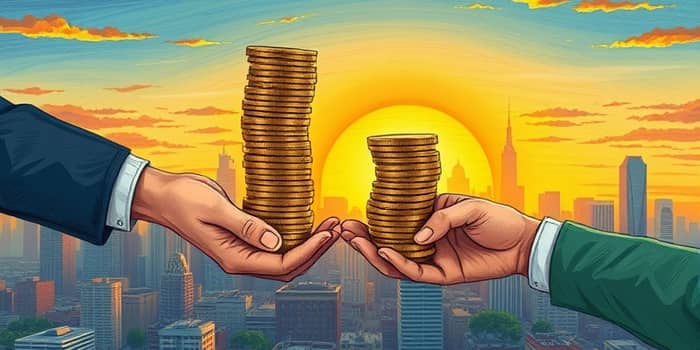
We live in an era where a handful of individuals command vast fortunes, owning assets far beyond what most people can imagine. At the same time, billions struggle each day to secure basic stability and build a financial cushion. This growing chasm between the wealthy and the rest is known as the wealth gap.
Understanding this phenomenon requires more than headlines about millionaires and billionaires—it demands a deep dive into definitions, figures, drivers, and solutions. By examining how assets and opportunities are distributed, we can see the stakes for social mobility, political stability, and shared prosperity.
Defining the Wealth Gap
The term wealth refers to assets minus liabilities, better known as net worth, a metric that captures someone’s overall financial position. Income inequality measures earnings disparities across a population. Wealth inequality, however, tracks the uneven accumulation of assets and debt, often displaying more extreme divides. Inequality of opportunity reflects circumstances individuals cannot control, such as family background, gender, or ethnicity.
By distinguishing between these concepts, we gain clarity on how assets exceed liabilities as net worth and why unequal accumulation of capital matters most in understanding social divides.
- Wealth: assets minus liabilities.
- Income inequality: uneven earnings distribution.
- Wealth inequality: uneven net worth distribution.
- Inequality of opportunity: driven by uncontrollable circumstances.
- Within-country inequality: disparities inside nations.
- Between-country inequality: gaps across borders.
Global Disparities and Eye-Opening Figures
On a worldwide scale, the vast imbalance of global wealth has reached unprecedented levels. In 2023, the top 1 percent of adults—those with over $1 million in net worth—held 47.5 percent of all global assets, equal to roughly $214 trillion. Meanwhile, nearly 40 percent of the adult population owned less than $10,000 in assets and controlled under 1 percent of global wealth. Remarkably, the wealthiest 0.001 percent possess three times more assets than the bottom half of humanity, emphasizing how extreme this divide has become.
- The richest 1 percent owned roughly $214 trillion.
- Nearly 40 percent of adults held under $10,000 and controlled less than 1 percent of wealth.
- The top 0.001 percent possess three times more wealth than the bottom half of the world.
- Their global share rose from 3.7 percent in 1995 to 6.1 percent in 2025.
The U.S. Landscape and Racial Dimensions
The United States stands out among major economies for its extreme concentration of assets. The top 10 percent of households own more than two-thirds of national wealth, while the top 1 percent alone holds nearly as much as the bottom 90 percent combined.
Racial disparities in asset accumulation are especially glaring. Policy decisions, historical discrimination, and barriers to homeownership have perpetuated a persistent, deeply entrenched disparity that spans generations.
Drivers Behind the Growing Divide
Multiple forces converge to widen the chasm between the wealthy and the rest. Technological progress and automation have boosted productivity but left many workers behind. Globalization and offshoring have created new markets while hollowing out domestic industries. Meanwhile, policy choices favoring the wealthy and tax reforms have sheltered top incomes, reinforcing existing advantages. In labor markets, rising output has not been matched by paychecks, a phenomenon often described as productivity gains without wage growth.
- Technological change and automation shifting gains upward.
- Policy decisions such as tax cuts and deregulation favoring top earners.
- Stagnant wages despite rising productivity.
- Decline of unions and weak social safety nets.
- Unequal investment in education and early opportunity.
Why the Wealth Gap Matters
Beyond moral considerations, widening inequality carries tangible risks. High disparity can erode trust in institutions, fuel social discontent and political polarization, and undermine democratic governance. When vast fortunes translate into political influence and power, policy can tilt further toward entrenched interests.
Inequality also impairs economic mobility, making it harder for children from modest backgrounds to attain a stable, middle-class life. Unequal access to quality schools, healthcare, and safe neighborhoods locks entire communities into poverty traps and limits the potential for innovation and growth.
Paths to Bridging the Divide
While the scale of the problem can feel overwhelming, a combination of policy reforms, institutional innovation, and collective will can narrow the gap. Progressive taxation and public investment—including wealth or inheritance taxes—can curb extreme concentrations of assets and fund programs that enhance opportunity.
Strengthening social supports, expanding affordable housing, and boosting workforce training programs ensure that productivity gains benefit a broader share of society. Strengthening labor rights and wages can help workers capture the rewards of economic growth more fairly.
Ultimately, redefining success—beyond individual accumulation toward shared flourishing—can inspire partnerships between governments, businesses, and communities. By recognizing that wealth inequality is shaped by choices, not fate, societies can forge strategies for economic opportunity and mobility that uplift all citizens.
Collective action at local, national, and global levels can transform the wealth gap from a source of division into a catalyst for innovation, inclusion, and lasting stability. The path forward demands courage, empathy, and a steadfast commitment to building systems where everyone has a chance to thrive.
References
- https://inequality.org/facts/global-inequality/
- https://www.brookings.edu/articles/rising-inequality-a-major-issue-of-our-time/
- https://www.oxfamamerica.org/explore/issues/economic-justice/income-and-wealth-inequality/
- https://sites.lsa.umich.edu/mje/2022/02/08/rising-economic-inequality-in-the-us-key-statistics-and-root-causes/
- https://www.un.org/en/un75/inequality-bridging-divide
- https://www.pewresearch.org/global/2025/01/09/factors-seen-as-contributing-to-economic-inequality/
- https://ourworldindata.org/economic-inequality
- https://wealthproject.gc.cuny.edu/digital-library-of-research/determinants/
- https://wid.world
- https://www.chicagofed.org/research/content-areas/mobility/policy-brief-extreme-wealth-inequality
- https://apps.urban.org/features/wealth-inequality-charts/
- https://inequality.org/facts/wealth-inequality/
- https://en.wikipedia.org/wiki/List_of_countries_by_income_inequality
- https://www.imf.org/en/topics/inequality/introduction-to-inequality
- https://pmc.ncbi.nlm.nih.gov/articles/PMC5560613/