
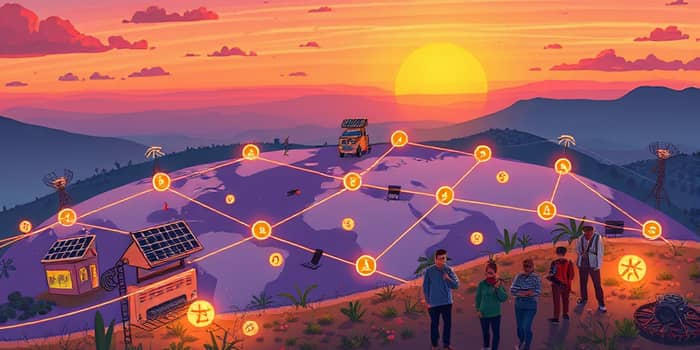
Across the globe, critical services like connectivity, compute power, and energy have traditionally been provided by large, centralized corporations. This model often leaves regions underserved, innovation stifled, and costs high. In contrast, DePIN (Decentralized Physical Infrastructure Networks) offers a radical new approach, harnessing blockchain, token incentives, and community participation to build and maintain real-world physical infrastructure in a bottom-up fashion.
Understanding DePIN: A New Paradigm
At its core, DePIN uses blockchain and crypto incentives to coordinate, fund, and operate networks of devices that deliver tangible services. Participants deploy hardware—hotspots, servers, sensors, solar panels, and more—and earn tokens for verifiable contributions such as coverage, uptime, throughput, and energy delivery. This model flips the traditional script: rather than waiting for corporate rollouts, individuals worldwide can instantly contribute resources and be rewarded.
Often described as the “real-world infrastructure layer of Web3,” DePIN bridges digital finance and physical systems. Projects range from decentralized wireless coverage and distributed computing to community microgrids and autonomous mobility networks. By tokenizing ownership and governance, these networks foster bottom-up and community-driven expansion, democratizing access and aligning incentives between providers and users.
Architecture and Mechanics of DePIN
A typical DePIN protocol comprises three core layers. First, the blockchain coordination layer tracks resource contributions, verifies activity, and handles reward distribution and governance. Second, the physical hardware layer consists of devices like routers, GPUs, solar arrays, and sensors that perform useful work. Third, the crypto-economic layer defines token issuance, reward schedules, usage credits, and governance tokens.
Devices on the network perform tasks—providing wireless coverage, storing data, computing workloads, or generating energy. Verification mechanisms such as proof-of-coverage, cryptographic proofs, or oracle feeds confirm performance. Smart contracts then mint and distribute tokens proportionally to verified contributions, while users pay for services via stablecoins or fiat-pegged usage credits.
Economic Design and the DePIN Flywheel
The economic heart of DePIN is its tokenomics, often characterized by a sustainable Burn-and-Mint Equilibrium mechanism. Native tokens are minted to reward infrastructure providers, while users burn tokens to access services. As real-world demand grows, token burns can outpace emission, creating value accretion and strengthening the incentive loop. This DePIN Flywheel aligns growth on both supply and demand sides.
Key design challenges include determining the right issuance schedule to incentivize early participants without flooding the market, establishing stable usage pricing anchored to fiat to remain competitive, and managing price volatility to ensure predictable returns. Governance via decentralized autonomous organizations allows token holders to adjust parameters over time, ensuring protocols evolve in response to real-world usage and market conditions.
Key Benefits of DePIN
DePIN holds transformative potential across multiple dimensions. By replacing centralized capital-intensive models with crowdsources capex from many small operators, these networks can deploy rapidly, reduce costs, and open access to underserved regions. Moreover, community-driven infrastructure is inherently more resilient, censorship-resistant, and aligned with participant incentives.
- Cost Efficiency & Capital Formation: Smaller operators collectively fund and build networks, eliminating rent-seeking intermediaries.
- Scalability & Speed: Organic, incremental deployments enable networks to grow where demand exists, from urban centers to remote villages.
- Resilience & Censorship-Resistance: Distributed nodes reduce single points of failure and resist centralized control or shutdown.
- Democratized Ownership: Token governance empowers users and operators with direct stakes and decision-making rights.
- Unlocking Underutilized Assets: Idle GPUs, bandwidth, solar panels, and sensors become income-generating through network participation.
Limitations and Risks
Despite its promise, DePIN faces significant risks. Token price volatility can undermine provider economics, as operators paid in fluctuating tokens may struggle to forecast returns. Unsustainable emission schedules can trigger boom-bust cycles of hardware deployments, while regulatory uncertainties around securities, data privacy, and telecom licensing loom large.
Additional challenges include ensuring non-speculative, persistent demand for services beyond token trading and maintaining robust verification systems to prevent fraudulent contributions or Sybil attacks. Effective governance is essential to adapt protocol parameters, reward rates, and onboarding criteria in response to evolving network conditions.
- Price Volatility & ROI Risk: Fluctuating token values can erode predictable provider revenues.
- Regulatory Uncertainty: Securities laws, telecom licensing, and data regulations vary by jurisdiction.
- Verification & Security: Ensuring accurate proofs of physical work to prevent fraud.
- Demand Sustainability: Long-term viability hinges on real service usage, not speculation.
The Road Ahead: Future Outlook in DePIN
Looking forward, DePIN stands poised to revolutionize how we build and own infrastructure. As protocols mature, tokenomics stabilize, and demand for decentralized services grows, these networks could underpin global connectivity, computing, and energy systems. Emerging hybrid models may leverage both on-chain governance and strategic partnerships with traditional providers to bridge regulatory gaps and accelerate adoption.
Innovation at the edge will continue to flourish, with entrepreneurs experimenting on new hardware, verification techniques, and incentive structures. Whether enabling mesh networks in remote communities, powering AI workloads on distributed GPUs, or coordinating solar microgrids, DePIN demonstrates the power of permissionless participation and underutilized assets in reshaping the future of infrastructure.
Ultimately, the true promise of DePIN lies not only in its technical architecture or tokenomics but in its ability to unite individuals, align incentives, and create resilient, democratized systems that serve communities worldwide. As this ecosystem evolves, participants and observers alike will witness a fundamental shift in how infrastructure is funded, built, and governed—inspiring a new era of collective ownership and innovation.
References
- https://www.certik.com/blog/what-are-decentralized-physical-infrastructure-networks-depins
- https://www.binance.com/en/square/post/294403031392722
- https://thegraph.com/blog/the-future-of-depin/
- https://chain.link/article/decentralized-physical-infrastructure-depin
- https://www.quicknode.com/builders-guide/best/top-10-decentralized-physical-infrastructure-networks
- https://www.titannet.io/learn/basics/best-depin-projects-2026-top-decentralized-physical-infrastructure-networks
- https://www.ankr.com/blog/depin-decentralized-physical-infrastructure/
- https://orochi.network/blog/top-10-de-pin-projects-and-emerging-trends-in-2026
- https://a16zcrypto.com/posts/article/6-use-cases-for-depin/
- https://gomining.com/blog/dpin-is-the-next-big-thing-in-2026-crypto
- https://www.frontiersin.org/journals/blockchain/articles/10.3389/fbloc.2025.1644115/full
- https://bitcoin.tax/blog/best-depin-coins-2026/
- https://arxiv.org/html/2406.02239v1
- https://www.blockchainappfactory.com/depin-guide-2026
- https://www.youtube.com/watch?v=23YrN6PVnis