
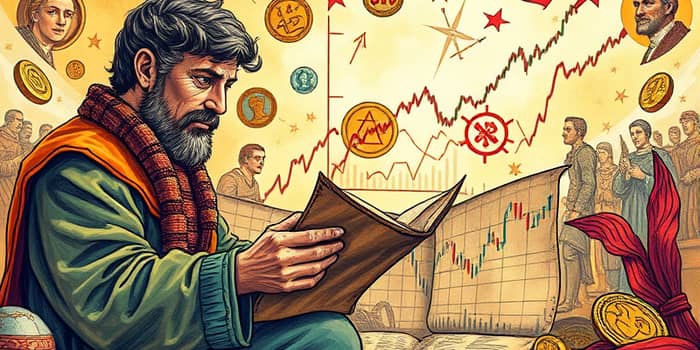
For centuries, investors have navigated booms, busts, bubbles, and breakthroughs. By studying history’s greatest triumphs and failures, we can extract lessons that remain strikingly relevant today.
This article weaves together insights from legends like Howard Marks, John Bogle, Benjamin Graham, and more, revealing the threads of timeless wisdom that underpin successful investing.
The Foundation of Common Sense
At the heart of every enduring investment approach lies common sense and flexibility. Howard Marks emphasizes that rigid formulas and blind model-following often lead to disaster. Instead, investors should blend fundamental logic with the adaptability to respond when markets shift.
Marks warns against mistaking market outperformance for true success. As Seth Klarman reminds us, “Beating the market matters, but limiting risk matters just as much.” Pursuing only relative gains can leave you badly exposed when volatility strikes.
- Ground your decisions in observable fundamentals.
- Maintain flexibility to adjust as conditions change.
- Distinguish between absolute returns and relative outperformance.
- Always ask: what risks lie beneath the surface?
By combining reason with adaptability, investors cultivate resilience, able to withstand surprises and shifting cycles.
Contrarian Intelligence and Second-Level Thinking
First-level thinking asks, “What will happen?” Second-level thinking asks, “What will happen versus expectations?” This distinction underpins second-level thinking, the engine of contrarian success.
Imagine predicting a company’s earnings decline but realizing the market expects a collapse. Buying on the potential pleasant surprise can deliver outsized returns. Yet simply swimming against the crowd is not enough—you must be more right than the consensus.
David Swensen captured this tension: “Investment success requires sticking with positions made uncomfortable by their variance with popular opinion.” Conviction, rigorous analysis, and a disciplined process empower investors to hold unpopular views until value emerges.
Lessons from Financial Titans’ Mistakes
Even legends stumble. Studying their missteps reveals essential truths about humility and risk management.
Graham’s miscalculation in 1929 showed that no investor is immune to unprecedented shocks. Livermore’s meteoric rise and fall underscore why you must always limit the potential downside. And LTCM’s near-collapse teaches us that models based on historical correlations can fail when markets behave in new ways.
The Value of Time, Costs, and Patience
John Bogle championed simple, low-cost investing. His mantra: time in the market beats timing the market. Over decades, reversion to the mean erases most outperformance, while fees and turnover relentlessly erode returns.
- Embrace low-cost, diversified vehicles like index funds.
- Keep realistic expectations about achievable gains.
- Resist speculative impulses and frequent trading.
- Honor the margin of safety principle in every position.
By minimizing costs and holding for the long term, investors capture the market’s growth without paying for conjecture or costly churn.
Building Your Own Historical Framework
Mark Kemp’s four-century narrative reminds us that markets are shaped by psychology and narratives as much as by numbers. From the Dutch East India Company to modern tech bubbles, themes repeat: euphoria, panic, and eventual reversion.
To harness history:
- Distill recurring patterns across eras.
- Develop personal rules grounded in reason and evidence.
- Stay skeptical of each “new paradigm” claim.
Experience trains the eye to spot extremes of pessimism and greed before they resolve. Yet history is a guide, not a script. Outliers will always emerge, and surprises will occur outside recorded norms.
Putting Uncommon Sense into Practice
How can you apply these lessons now? Begin by crafting a process that balances ambition with caution:
- Define clear objectives: absolute returns over a cycle, not just relative outperformance.
- Assess intrinsic value versus market expectations, seeking discrepancies.
- Prioritize risk control over aggressiveness, cutting losers swiftly.
- Maintain conviction in well-researched, unpopular ideas.
Finally, commit to lifelong learning. Read widely—financial history, psychology, and biographies. Reflect on mistakes, both yours and others’. Over time, your personal “uncommon sense” will become a powerful compass, guiding you through every market climate.
Investment success is rarely born of dazzling forecasts or complex algorithms. Instead, it arises from the patient application of durable principles, humility before uncertainty, and the courage to think differently. By blending history’s wisdom with disciplined action, you too can master the uncommon sense that underpins lasting returns.
References
- https://novelinvestor.com/notes/the-most-important-thing-uncommon-sense-for-the-thoughtful-investor-by-howard-marks/
- https://www.morningstar.com/stocks/15-stocks-that-have-destroyed-most-wealth-over-past-decade
- https://www.goodreads.com/book/show/26880943-uncommon-sense
- https://www.youtube.com/watch?v=Wzi3BV90wUo
- https://www.aesinternational.com/blog/10-common-sense-investing-lessons
- https://www.failory.com/blog/shark-tank-failures
- https://www.youtube.com/watch?v=AnHDF8mRPms
- https://exclusive.multibriefs.com/content/the-worst-of-the-best-5-blunders-made-by-successful-investors
- https://awealthofcommonsense.com/2020/12/my-2020-investing-lessons/
- https://awealthofcommonsense.com/2026/01/2025-investing-lessons/
- https://www.youtube.com/watch?v=CK5Xw-w00nE