
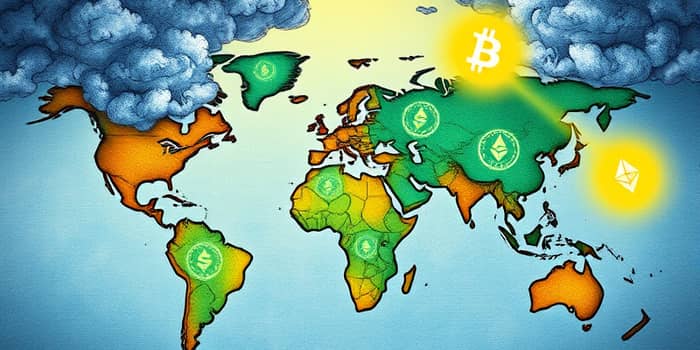
Cryptocurrency markets do not move in a vacuum. They respond powerfully to shifts in politics, conflict, and monetary policy around the world. By understanding these forces, investors can navigate volatility and seize opportunities.
Why Macro Matters Now
In the years since 2020, crypto assets like Bitcoin and Ethereum have grown from niche experiments into mainstream instruments. Yet they remain highly sensitive to global catalysts and crises. Images of election night rallies or central bank announcements now drive price swings as much as technical upgrades or protocol forks.
This duality—trading as both a speculative asset and a potential safe haven—means that every war, policy shift, or regulatory decision reverberates through digital markets with extraordinary force.
Political Events and Elections
Elections and leadership changes often introduce sudden policy pivots. In the 2024 US presidential contest, Bitcoin and Ethereum experienced sharp moves as candidate platforms highlighted contrasting visions for digital currencies. When the winning administration signaled a pro-crypto regulatory environment, Bitcoin surged past US$100,000.
Similarly, localized instability can drive flow into homegrown tokens. Late in 2024, unrest in South Korea prompted a spike in TRON trading volumes and prices, showcasing how instability accelerates adoption of certain assets on a regional scale.
Geopolitical Conflicts and Sanctions
Wars and sanctions create both flight-to-safety demand and risk-off pressure. Residents in sanctioned or crisis-stricken nations often turn to Bitcoin or stablecoins to preserve capital and bypass capital controls. Yet concurrently, rising interest rates and recession fears can send crypto lower along with equities.
- Safe-haven demand: Bitcoin as “digital gold” in acute crises
- Capital flight: stablecoins for cross-border transfers
- Risk-off cascades: tighter conditions draining liquidity
The Russia–Ukraine conflict from 2022 onward illustrated this duality vividly. Initial price gains gave way to sell-offs as global rate hikes took center stage, proving crypto’s dual identity as both risk asset and hedge.
Monetary Policy and Macro Cycles
Central bank decisions on interest rates remain the most potent macro driver for cryptocurrencies. When the US Federal Reserve embarked on a hawkish tightening cycle in 2022–2024, Bitcoin and other high-beta assets saw steep declines. Conversely, anticipated rate cuts in 2025–2026 have analysts forecasting renewed bull runs.
Scenario forecasts from leading firms suggest Bitcoin could approach $180,000 and Ethereum $8,000 if easing outpaces market expectations. These figures underscore how macro liquidity shapes crypto valuations over both short and long horizons.
Regulation, ETFs, and Institutional Adoption
The approval of spot Bitcoin ETFs in early 2024 marked a watershed moment. It created a continuous demand mechanism for institutional capital, lowering barriers for pension funds, family offices, and advisors to access crypto via familiar wrappers.
Regulatory clarity tends to stabilize markets, while uncertainty fuels volatility. As more regions explore tokenized municipal bonds and central bank digital currencies, on-chain public finance could weave crypto even deeper into fiscal policy frameworks.
Tools and Indicators for Tracking Macro Catalysts
Investors can harness a suite of indicators to stay ahead of macro shifts:
- Economic calendars: monitor Fed, ECB, BoJ meeting dates and statements
- Sentiment indices: gauge risk appetite via VIX, bond yield spreads, crypto volatility metrics
- On-chain flows: track ETF inflows, stablecoin minting, exchange reserves
Combining traditional macro data with blockchain analytics provides a comprehensive view of shifting liquidity conditions.
Case Studies: 2020–2026 in Review
Several episodes illustrate how macro events shaped crypto trends:
- 2020 US election and post-pandemic stimulus: Bitcoin rallied as fiscal stimulus inflated global liquidity.
- 2022 energy shock and inflation surge: commodity price spikes drove rate hikes, triggering crypto drawdowns.
- 2023 Middle East tensions: brief risk-off sell-offs followed by recoveries as markets priced in supply chain risks.
These case studies underscore the importance of timing entries and exits around policy announcements and geopolitical flashpoints.
Strategy Implications for Investors
To harness macro cycles in crypto:
- Define risk parameters: set position sizes relative to expected volatility.
- Stagger exposure: build positions ahead of anticipated easing or regulatory clarity.
- Hedge selectively: use options or inverse products to manage drawdown risk around major events.
Ultimately, a disciplined approach that aligns crypto allocations with broader portfolio objectives will outperform ad hoc trading on headlines.
Conclusion: Crypto as a Macro Asset Class
As crypto markets mature, they increasingly behave like other macro-sensitive asset classes—yet retain unique on-chain signals that offer early warnings of liquidity shifts. By integrating geopolitical awareness, policy calendars, and blockchain analytics, investors can transform uncertainty into opportunity.
The macro view of global events and crypto prices reveals a landscape where every election, conflict, and rate decision can redefine market trajectories. Armed with the right tools and a strategic mindset, market participants can navigate this dynamic terrain and unlock the long-term potential of digital assets.
References
- https://crypto.com/us/university/how-do-political-events-affect-crypto-markets
- https://mercuryo.io/explore/learn/crypto-trends-2026
- https://rango.exchange/learn/crypto-basics/global-events-bitcoin-prices
- https://bitcoinsuisse.com/outlook/2026
- https://www.altrady.com/crypto-trading/fundamental-analysis/geopolitical-events-crypto-prices
- https://fintech.tv/crypto-market-2026-bitcoin-ethereum-defi-trends/
- https://www.binance.com/en/square/post/17251756490649
- https://www.svb.com/industry-insights/fintech/2026-crypto-outlook/
- https://coinmarketcal.com/en/
- https://panteracapital.com/blockchain-letter/navigating-crypto-in-2026/
- https://www.investing.com/crypto
- https://www.binance.com/en/square/post/35247701823258
- https://www.coinbase.com/institutional/research-insights/research/market-intelligence/2026-crypto-market-outlook
- https://blog.kraken.com/crypto-education/crypto-markets-in-2026
- https://www.youtube.com/watch?v=naVbtmtVk48