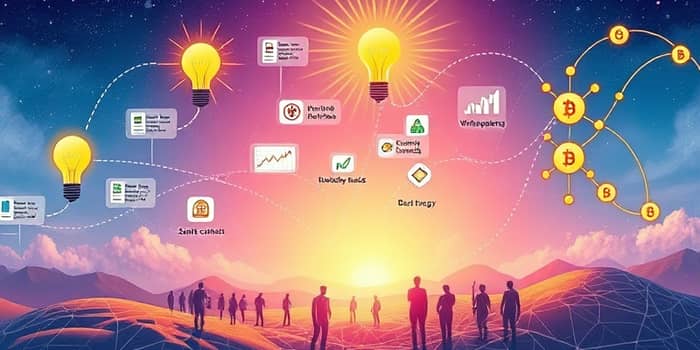
In a rapidly evolving digital landscape, launching a crypto project demands clarity, strategy, and community engagement. This article guides founders, developers, and enthusiasts through each critical stage of the journey, from initial spark to sustainable ecosystem.
Whether you dream of redefining finance, gaming, identity, or governance, understanding the lifecycle equips you with the insights needed to navigate challenges and seize opportunities.
Understanding the Crypto Project Lifecycle
The crypto project lifecycle parallels traditional project management but introduces token dynamics, open-source collaboration, and on-chain governance. At its core, it moves through stages of ideation, design, development, launch, adoption, and maturity or decline. Each phase integrates technical, economic, and social dimensions.
- Ideation & Problem Definition
- Architecture, Whitepaper & Tokenomics
- Technical Development & Testnet
- Roadmap, Strategy & Fundraising
- Token Generation & Market Listing
- Ecosystem Growth & Governance
- Maturity & Evolution
Stage 1 – Ideation & Problem Definition
Every project begins with a question: what real-world or on-chain problem needs solving? Founders conduct rigorous market research, surveying user needs, identifying gaps in existing protocols, and evaluating the necessity of blockchain over centralized databases.
Building a balanced team is equally essential. Core developers write smart contracts, token economists design incentive structures, legal advisors navigate compliance, and community managers foster engagement. Early validation may include prototype demos at hackathons, small-scale experiments on GitHub, or peer reviews among blockchain researchers.
Defining a strong mission statement and vision aligns stakeholders and inspires early adopters. This foundation, often codified in a project whitepaper and website, signals seriousness and builds initial trust.
Stage 2 – Architecture, Whitepaper & Tokenomics
This phase transforms abstract ideas into concrete designs. The whitepaper functions as both a technical blueprint and investment prospectus, detailing consensus mechanisms (PoS, PoW, PoA), smart contract platforms (EVM, Substrate, Cosmos SDK), and governance frameworks.
Tokenomics design determines how value circulates. Teams set total token supply and distribution plan, establish vesting schedules, and define utility roles such as staking rewards, governance rights, or in-app currency. Misaligned incentives—such as excessive early unlocks—can trigger sharp sell-offs, undermining community confidence.
Roadmaps accompany tokenomics, laying out milestones over months and years. Quality roadmaps balance ambition with practicality, matching team capacity and resource availability. Transparent updates on progress or delays maintain credibility with backers and users alike.
Stage 3 – Technical Development & Testnet
With designs finalized, the project transitions to coding and infrastructure setup. Teams choose between building a new blockchain or deploying on established networks like Ethereum, Solana, or BNB Chain. This decision impacts security, transaction costs, and developer accessibility.
- Node infrastructure and consensus setup including validators and block time configurations
- Smart contract development, auditing, and formal verification
- API design for wallets, explorers, and external integrations
- Front-end and back-end architecture, focusing on UX and scalability
Deploying a testnet or releasing an MVP allows community members and security auditors to uncover bugs, performance issues, and UX friction points. Iterative feedback loops refine the protocol, ensuring that the mainnet launch proceeds with confidence and stability.
Stage 4 – Roadmap, Strategy & Fundraising
A well-articulated roadmap outlines both technical and business milestones, from alpha releases and cross-chain bridges to marketing campaigns and partnership rollouts. Each milestone should connect to clear metrics such as user growth, total value locked (TVL), or transaction throughput.
Fundraising leverages multiple channels: traditional equity rounds with VCs, private token sales to strategic investors, public IDOs on decentralized launchpads, and grant programs from ecosystem foundations or governmental bodies. For example, the European Commission’s Horizon 2020 grants injected over €180 million into blockchain research, illustrating the role of public funding in spurring innovation.
Strategic investors often bring more than capital; they provide mentorship, market access, and an extended network. Balancing dilution and token distribution timing is vital to avoid stifling early community momentum.
Stage 5 – Token Generation Event & Market Listing
The Token Generation Event (TGE) marks the moment tokens are minted and allocated to stakeholders. Coordinating a TGE involves synchronizing smart contract deployments, security audits, and distribution infrastructure to ensure faultless execution.
Listing strategies may combine centralized exchange (CEX) partnerships for deep liquidity and decentralized exchange (DEX) campaigns for community-driven trading. Offering initial liquidity incentives or staking programs can attract early users and create price stability.
Post-listing, teams must monitor on-chain metrics, community sentiment, and market depth. Establishing governance processes—whether through token-weighted voting or delegated frameworks—empowers holders to guide protocol evolution and maintain alignment with long-term goals.
Stage 6 – Ecosystem Growth & Governance
True success is measured by ecosystem vitality. Projects foster developer communities with hackathons, developer grants, hackathons, liquidity mining, and collaborative tooling. Integrations with wallets, data providers, and layer-2 networks expand reach and functionality.
Community governance frameworks translate collective decisions into protocol upgrades. Examples include Uniswap’s governance votes on fee adjustments or MakerDAO’s stability fee proposals. Transparent governance builds trust and prevents concentration of power.
Stage 7 – Maturity, Evolution & Sustainability
At maturity, projects face the challenge of sustaining momentum. Continuous improvements—such as Ethereum’s transition to Ethereum 2.0 and Polkadot’s parachain auctions—demonstrate how protocols evolve to address scalability, security, and environmental considerations.
Financial sustainability arises from diversified revenue streams: protocol fees, partnerships, enterprise adoption, and treasury investments. Effective treasury management and open budgets ensure that the project can navigate market downturns and invest in future innovations.
By mastering each stage—from establishing problem–solution fit and sector analysis to nurturing a self-sustaining ecosystem—teams can guide their vision through challenges and market cycles. A successful crypto project balances innovation with prudent planning, community trust, and transparent governance.
As you embark on your journey, remember that the lifecycle is not strictly linear. Continuous learning, adaptability, and collaborative spirit will propel your project from a simple idea to a vibrant, resilient ecosystem.
References
- https://web3.bitget.com/en/academy/crypto-lifecycle-for-investors-how-to-spot-opportunities-at-every-stage
- https://cryptorank.io/funding-rounds
- https://blog.whitebit.com/en/what-is-a-project-roadmap/
- https://digital-strategy.ec.europa.eu/en/policies/blockchain-funding
- https://www.ifourtechnolab.com/blog/blockchain-project-development-life-cycle
- https://qubit.capital/industries/blockchain
- https://www.ledger.com/academy/crypto-market-cycles-how-to-read-them-why-they-matter
- https://coinlaunch.space/events-rounds/strategic/
- https://www.coursera.org/articles/project-management-lifecycle
- https://aurum.law/newsroom/Private-Financing-for-Blockchain-Projects-and-Crypto-Startups
- https://instituteprojectmanagement.com/blog/project-life-cycle/
- https://growthequityinterviewguide.com/venture-capital/sector-focused-venture-capital/blockchain-venture-capital
- https://www.atlassian.com/work-management/project-management/project-life-cycle
- https://hashlock.com/services/crypto-capital-venture-funding
- https://onlinelibrary.wiley.com/doi/full/10.1002/cend.202400022