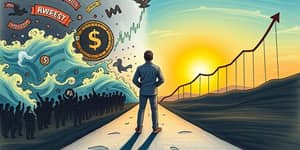

In a world of rapid information flow and intense competition, finding an edge in investing can seem fleeting. Yet, an investor’s true advantage often lies not in crystal-ball forecasts but in adhering to a disciplined process rather than prediction. This article explores how to cultivate and maintain that edge across any market environment by combining multiple strategies and principles into a coherent framework.
What Does an Investor’s Edge Really Mean?
An edge in investing represents any factor that allows you to achieve better outcomes than the average market participant. Financial markets are generally efficient, making sustained outperformance challenging. Periods of predictability exist but are typically brief and vanish as others exploit them. Recognizing the impermanent and conditional nature of advantage is the first step toward building a robust approach.
Key Components of a Sustainable Investing Edge
Rather than seeking a single silver bullet, successful investors blend various elements into a unified plan. Your edge is often the result of:
- information quality
- analysis framework and rigor
- process discipline
- portfolio construction
- behavioral control
- time horizon
- opportunistic rebalancing during volatility
The Three Kinds of Investing Edge
Any advantage can be categorized into three broad types, each with its own characteristics and lifespan.
The holy grail—the informational edge—is inherently fragile. Analytical edges, when built on robust models, can persist but may erode as assumptions shift. Institutional advantages often stem from flexibility, access, or scale that most retail investors cannot replicate.
Leveraging Discipline and Behavioral Control
Market turbulence often reveals the greatest test of an investor’s character. Emotional reactions can destroy value, while restraint can compound it.
- Avoid panic selling during downturns
- Maintain exposure to your target allocation
- Focus on long-term objectives over short-term noise
Exercising the ability to stay rational when others do not can help you avoid the most common investing pitfalls. Discipline often yields better results than chasing the latest market fad.
Diversification, Allocation, and Rebalancing
One of the most repeatable edges is structural: diversification. Spreading risk across asset classes, sectors, and geographies reduces vulnerability to any single shock.
A classic example is the 60% equities / 40% bonds portfolio, which balances growth potential with stability. Beyond this template, you can diversify within equities (large cap, small cap, international) and fixed income (government, corporate, short-term).
Over time, market movements will cause your allocation to drift. Regular rebalancing enforces systematic selling high and buying low, preserving the risk profile you designed. Without discipline, portfolios can become unintentionally overweight in assets that have already appreciated heavily.
Turning Volatility into Opportunity
Volatility is not an aberration but the norm. Large price swings are intrinsic to markets and often trigger emotional reactions that generate mispricing.
- Use dollar-cost averaging to smooth entry points
- Rebalance when allocations diverge from targets
- Apply tax-loss harvesting to offset gains in taxable accounts
By planning for volatility, you gain the confidence to act when prices are attractive instead of being paralyzed by fear. This tactical edge can compound returns over full market cycles.
The Power of Time Horizon and Compounding
Time is perhaps the most underestimated edge. A long-term mindset and time horizon enable investors to ride out downturns and capture the benefits of compounding, where returns generate their own returns over years and decades.
In contrast to short-term trading, those who stay invested through thick and thin often outperform because they avoid locking in losses and give their winners room to grow.
Advanced Tactics for Active Traders
While our focus is on broad-based investing, active traders can harness stronger risk controls in volatile conditions. Tools such as stop-loss orders, smaller position sizing, and percentage-based profit targets help manage the heightened risk of rapid moves. However, these tactics require rigorous discipline and constant monitoring, distinguishing them from the systematic process used by long-term investors.
Crafting a Process to Sustain Your Edge
An edge built solely on a single insight will dissipate. The real power lies in a repeatable, documented process that guides decision-making.
A strong process includes clear written goals and investment policy, periodic review of assumptions and allocations, rules-based rebalancing, and disciplined cash management. Combining these with professional guidance or peer review can further strengthen your edge. Remember, the market’s only constant is change, so your process must evolve accordingly.
Conclusion: Sustaining Your Edge in Any Market
Gaining an advantage in investing is about assembling and maintaining a set of complementary tools rather than relying on a single insight. By integrating strong analytical frameworks, disciplined execution, structural diversification, and a long-term orientation, you can develop an edge that endures across market cycles. Ultimately, the greatest edge may be avoiding mistakes rather than outguessing markets.
In every market environment, those who stay true to their process and manage behavior wisely will find opportunities where others see obstacles. Cultivate these principles to ensure your investing edge remains sharp, no matter what the future holds.
References
- https://acquirersmultiple.com/2019/10/the-3-investment-edges-every-investor-should-be-seeking/
- https://www.citizensbank.com/learning/how-you-can-prepare-for-a-volatile-market.aspx
- https://today.ucsd.edu/story/getting-an-edge-in-todays-financial-markets-is-possible-but-it-wont-last
- https://www.rcbc.com/how-to-invest-in-volatile-markets
- https://insideedgecapital.com/our-insight/market-maturation-from-tech-concentration-to-broad-participation/
- https://international.schwab.com/investing-education/how-traders-can-take-advantage-volatile-markets
- https://www.newedgewealth.com/the-investors-edge-key-trends-driving-todays-markets/
- https://www.ml.com/articles/dealing-with-the-markets-latest-roller-coaster-ride.html
- https://www.youtube.com/watch?v=TUGb1LLeB1A
- https://www.rbcgam.com/en/ca/learn-plan/investment-basics/5-things-to-keep-in-mind-when-markets-are-volatile/detail
- https://www.theinvestorsedge.com/real-estate-investing-for-beginners
- https://investor.vcm.com/insights/investor-learning/how-to-invest-in-a-volatile-market
- https://www.youtube.com/watch?v=NpuRoAhfxUI