
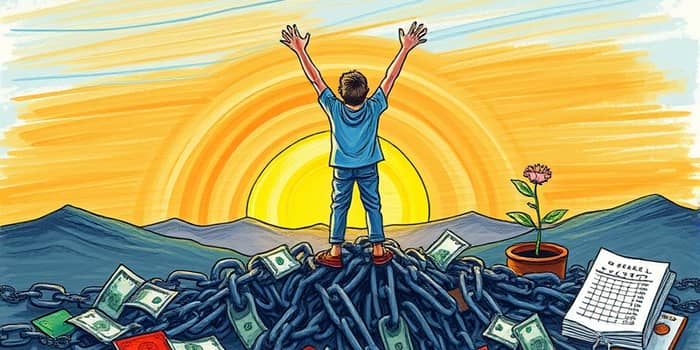
Overwhelmed by debt? You’re not alone—and you can reclaim control of your financial future.
Understanding the Debt Spiral
Before you launch your escape, it’s vital to grasp how debt grows and why it traps so many people.
- Using new credit to pay old debts creates a vicious cycle of growing balances.
- High interest rates (20–30% APR on credit cards) cause balances to balloon faster than payments reduce them.
- Making only minimum payments often leads to decades of repayment and hefty interest charges.
- Psychological stress and shame can lead to avoidance, making the problem feel insurmountable.
Recognizing these patterns is your first step toward designing a custom escape plan that actually works.
Step 1: Assess Your Situation
Start with a clear snapshot of your debts. Gather details for each account:
- Creditor name and type (credit card, payday loan, auto loan).
- Current balance including any accrued interest.
- Interest rate (APR) and minimum monthly payment.
- Payment due dates and account status (current or in collections).
Then calculate your total debt and monthly minimums. This inventory reveals exactly where you stand and how much of your income is already committed.
Step 2: Build a Budget That Works
With your debt inventory in hand, create a realistic spending plan.
Follow these steps:
- List all after-tax income sources: salary, side gigs, benefits.
- Record fixed essentials: rent, utilities, insurance, groceries, transportation, and minimum debt payments.
- Track variable expenses: dining out, subscriptions, entertainment, impulse purchases.
- Identify cutback opportunities—dining out less or pausing unused services—and assign those savings to debt payoff.
An adaptable framework like the 50/30/20 rule helps: 50% of income for needs, 30% for wants, 20% for savings and extra debt payments. In heavy-debt seasons, shift to 50% needs, 15% wants, 35% debt payoff.
Step 3: Choose Your Repayment Strategy
Select a method that balances mathematics with motivation. Here’s how the main approaches compare:
Always pay at least the minimum on every account. Then direct any extra funds to your chosen target. Even an additional $20 or $50 a month accelerates your journey and chips away at interest.
Step 4: Consider Consolidation and Professional Support
If you’re juggling multiple high-interest debts, consolidation can simplify payments and reduce rates.
- Personal consolidation loans can combine multiple balances into one with a lower APR.
- Balance transfer credit cards may offer 0% intro APR—watch for transfer fees.
- Nonprofit credit counseling agencies offer free budgeting workshops and can negotiate lower rates.
Professional guidance isn’t a sign of failure—it’s an investment in your financial health, providing accountability and expert negotiation.
Step 5: Maintain Momentum and Stay Debt-Free
Escaping debt is transformational, but staying free demands ongoing vigilance.
- Build a starter emergency fund of $1,000 to avoid new debt when surprises arise.
- Automate savings and extra debt payments—consistent actions yield lasting progress.
- Monitor your credit report regularly to spot errors or new issues.
- Adopt a mindset shift from scarcity to abundance by celebrating milestones and redirecting savings to goals.
Reflect on the story of Beverly Harzog. Despite a CPA’s expertise, she amassed over $20,000 in credit card debt. Her breakthrough came when she built a structured, personalized debt-reduction journey and committed to change. By pairing technical tactics with behavior shifts, she conquered her balances—and you can too.
Debt may feel like chains, but each payment, each budget adjustment, and each mindset shift hacks away at those bonds. Stay focused on your personalized plan, and you’ll experience the psychological boost of quick wins, the freedom of reduced interest, and ultimately the triumph of financial independence.
Ready to break free? Start today by assessing your debts, building a workable budget, selecting your payoff strategy, and seeking support when needed. With dedication and a clear roadmap, you will transform your finances and reclaim your future.
References
- https://madisoncu.com/breaking-free-10-practical-tips-to-escape-the-debt-spiral/
- https://www.navyfederal.org/makingcents/credit-debt/debt-repayment-strategies.html
- https://www.beverlyharzog.com/debt-escape-plan/
- https://www.equifax.com/personal/education/debt-management/articles/-/learn/paying-off-debt-strategies/
- https://financialfitnesscoaching.com/financial-fitness-blog/breaking-the-chains-how-to-escape-the-vicious-cycle-of-debt
- https://www.rivercityfcu.org/how-to-get-out-of-debt
- https://www.youtube.com/watch?v=_uz_inLiZoQ
- https://www.nerdwallet.com/personal-loans/learn/pay-off-debt
- https://www.experian.com/blogs/news/about/debt-escape-plan/
- https://www.westernsouthern.com/personal-finance/debt-reduction-strategies
- https://sjpl.bibliocommons.com/v2/record/S156C6400885
- https://consumer.ftc.gov/articles/how-get-out-debt
- https://www.badcredit.org/former-credit-junkie-shares-clever-tips-in-the-debt-escape-plan/
- https://www.militaryonesource.mil/resources/millife-guides/paying-off-debt/
- https://www.walmart.com/ip/The-Debt-Escape-Plan-How-to-Free-Yourself-From-Credit-Card-Balances-Boost-Your-Credit-Score-and-Live-Debt-Free-Edition-1-Paperback-9781601633606/39121641