
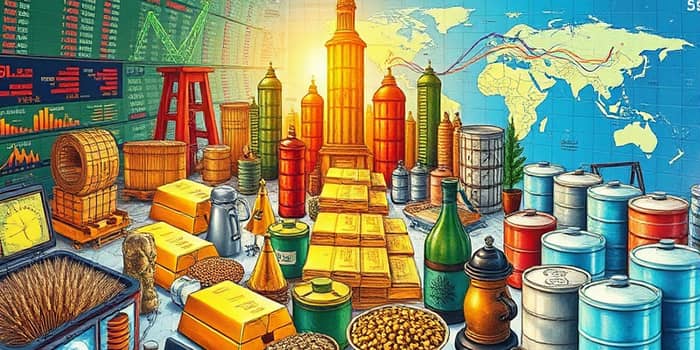
Traditional portfolios have long leaned on stocks, bonds, and cash, but as economic landscapes shift, investors seek new avenues to protect and grow wealth. The rise of alternative investments has opened doors to real assets and niche strategies, promising enhanced resilience during market volatility and fresh opportunities for income and growth.
Within this expanding universe, Exchange-Traded Commodities (ETCs) stand out as a bridge between hard assets and liquid, exchange-listed instruments. By offering direct commodity exposure in a familiar trading format, ETCs empower retail and institutional investors alike to tap into sectors once dominated by large funds and physical traders.
Diversification Beyond Stocks and Bonds
Core portfolios typically revolve around equities and fixed income, but this narrow focus can leave assets vulnerable to synchronized downturns and inflationary pressures. Investors turn to alternatives to achieve:
- Low correlation with traditional markets
- Inflation protection through tangible assets
- Unique income streams outside dividends and coupons
- Access to private and niche markets
Alternative investments span real estate, private equity, hedge funds, collectibles, and hard commodities such as precious metals and energy. Each category carries its own risk-return profile, liquidity constraints, and due diligence requirements.
What Are Exchange-Traded Commodities?
Exchange-Traded Commodities are securities traded on stock exchanges that track the price of individual commodities or baskets of commodities—everything from gold and silver to oil, natural gas, agricultural crops, and even carbon allowances. Unlike physical purchase, ETCs eliminate the burdens of storage, insurance, and delivery.
Typically structured as debt instruments or special purpose vehicles (SPVs), ETCs are backed by either:
- Physical holdings of the underlying commodity
- Futures contracts or total return swaps
This structure allows ETCs to replicate commodity prices closely while embedding costs such as storage or roll yields directly into the net asset value (NAV).
Structural Mechanics: Physical vs. Synthetic
ETCs follow two primary models—physical and futures-based—each with distinct characteristics:
Physical ETCs, dominant in precious metals, offer transparency and low issuer risk thanks to vault-held assets. Futures-based ETCs enable energy and soft commodity exposure where physical logistics would be impractical, yet they introduce roll yield considerations and counterparty dependencies.
According to industry reports, global ETC assets soared beyond $350 billion in 2024, reflecting a 14% year-over-year increase. Energy-based ETCs—covering oil, gas, and related products—accounted for 38% of all flows, illustrating strong investor demand. In Australia, commodity ETCs represent 14% of self-managed super fund alternative allocations, underscoring growing retail acceptance.
ETCs vs ETFs: Key Differences
Although ETCs and ETFs share the convenience of exchange listing, their legal and structural foundations differ markedly:
- Asset Focus: ETCs target raw commodities; ETFs predominantly track equity indexes, bond baskets, or diversified strategies.
- Legal Form: ETCs are debt securities issued by SPVs, secured by asset holdings or derivative collateral; ETFs are collective investment schemes subject to regulations like UCITS.
- Risk Profile: ETCs may carry issuer default risk, mitigated by collateral; ETFs benefit from asset segregation, diversification rules, and regulatory safeguards.
The concept of “commodity beta” further highlights their divergence: ETCs typically exhibit a beta near 0.87, delivering direct price sensitivity, while commodity-focused ETFs—often invested in producer equities—average a beta around 0.12.
Strategies and Practical Considerations
Incorporating ETCs into a portfolio demands careful planning. Key considerations include investment horizon, cost awareness, and risk management:
- Horizon Alignment: Long-term hedges versus short-term tactical positions
- Fee Analysis: Total expense ratios reflecting storage, swap, and roll costs
- Counterparty and Liquidity Reviews: Examine trading volumes, collateral quality, and issuer creditworthiness
Financial advisors stress the importance of rigorous due diligence and goal alignment. For many retail investors, a dedicated real asset sleeve—comprising precious metals, energy, and agriculture ETCs—can complement equities and bonds, enhancing diversification and inflation resilience.
Embracing Commodities in Modern Portfolios
Commodities reflect the pulse of global supply-demand dynamics and monetary trends. ETCs democratize this exposure, offering:
- Protection against currency depreciation and inflationary spikes
- Participation in commodity supercycles across metals, energy, or agriculture
- Non-correlated diversification to traditional financial assets
With record growth in assets under management and increasing adoption among retail and institutional investors, ETCs have cemented their role in diversified portfolios. By understanding the nuances of physical versus synthetic structures, cost drivers, and legal frameworks, investors can leverage ETCs to create more resilient and opportunity-rich investment strategies.
Ultimately, exchange-traded commodities offer a compelling pathway to blend the heritage of real assets with the efficiency of modern markets. Embrace this evolving asset class to expand your portfolio’s horizons and fortify it against tomorrow’s challenges.
References
- https://www.ubs.com/us/en/assetmanagement/education/etc-vs-etf.html
- https://www.supervest.com/blog/mastering-alternative-asset-investing-for-family-offices-and-financial-advisors
- https://discoveryalert.com.au/exchange-traded-commodities-etcs-2025-investment-guide/
- https://www.fidelity.com/learning-center/trading-investing/new-diversification
- https://www.justetf.com/en/academy/what-is-an-etc.html
- https://www.morganstanley.com/ideas/alternative-investments-portfolio-diversification
- https://hanetf.com/exchange-traded-commodities/
- https://www.mortonwealth.com/blog-posts/beyond-the-market-why-diversification-outside-of-stocks-and-bonds-matters-more-than-ever
- https://bux.com/knowledge/knowledge/invest-in/investing-in-etcs/
- https://www.firsttechfed.com/articles/invest/nontraditional-assets-can-complement-a-diversified-portfolio
- https://www.diyinvestor.net/exchange-traded-commodities-what-is-an-etc/
- https://birchstreetadvisors.com/blog/exploring-alternatives-beyond-traditional-investments
- https://www.blackrock.com/us/financial-professionals/insights/diversifying-multi-asset-portfolios
- https://www.youtube.com/watch?v=MEVHSpD3FBc