
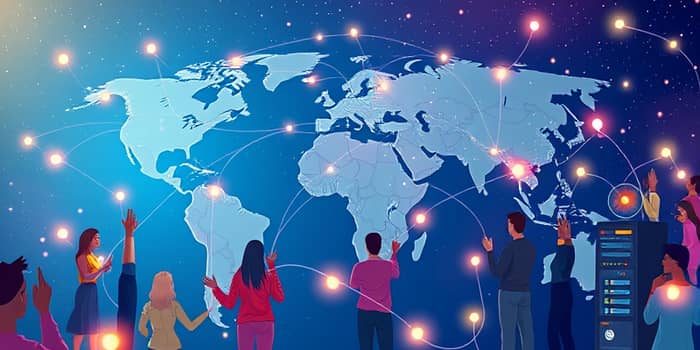
In an age dominated by centralized giants, decentralized social media emerges as a beacon of hope for users seeking control, privacy, and genuine connection.
The rise of platforms built on federated networks, blockchain protocols, and peer-to-peer systems marks a profound shift away from single-entity dominance toward distributed, community-led ecosystems.
Understanding Decentralized Social Platforms
At its core, decentralized social media operates without a single central authority managing content, data, or rules. Instead, it relies on networks of independent servers, consensus algorithms, or peer-to-peer (P2P) architectures.
These systems distribute hosting, moderation, and governance across users, nodes, or communities, enabling seamless interaction across instances much like email.
- Federated networks: Platforms like Mastodon and Bluesky use protocols such as ActivityPub to connect independent servers.
- Blockchain-based: Services like Lens Protocol and Steemit store content and identity on-chain for verifiable ownership.
- Distributed systems: Solutions powered by IPFS foster resilience by having nodes share and replicate data.
Together, these technical models form a collaborative ecosystem known as the “fediverse,” where users can interact across diverse applications under shared protocols.
Empowering Users: Autonomy and Data Control
One of the most compelling advantages is user-controlled data ownership. Participants choose or host servers, migrate profiles freely, and retain complete ownership over their information without corporate harvesting.
Decentralized networks also offer censorship resistance and privacy. Content on blockchain is immutable unless community consensus dictates otherwise, preventing arbitrary takedowns and ensuring transparency.
- Anonymous or wallet-based logins protect personally identifiable information (PII).
- Distributed hosting reduces single points of failure and large-scale outages.
- Open-source code invites inspection and customization, fostering trust.
By reclaiming control of personal data, users can navigate the digital sphere without fear of sudden deletions, unauthorized surveillance, or manipulative algorithms.
Inspiring Creators and Brands
Decentralized platforms open new avenues for monetization and engagement. Through token-based rewards, content creators earn crypto tips, NFTs, or governance tokens directly from their audience.
Smart contracts enable artists, writers, and influencers to establish transparent revenue-sharing agreements, fostering deeper fan relationships and eliminating intermediaries.
- Platforms like Steemit reward contributors with cryptocurrency payouts.
- Lens Protocol allows creators to issue subscription NFTs for exclusive content.
- Brands can leverage dedicated instances to build trust without selling user analytics.
This direct economic model empowers independent creators and brands to flourish on merit, bypassing opaque ad-driven algorithms.
Challenges on the Path to Decentralization
Despite its promise, decentralized social media faces notable hurdles. Community-led moderation can be less consistent than corporate oversight, potentially allowing hate speech or misinformation to proliferate on some instances.
Smaller user bases also limit network effects; while centralized platforms host billions, federated services often count only hundreds of thousands to a few million active users.
User experience can lag behind polished corporate apps. Interfaces may feel less intuitive, transaction fees on blockchain can cause friction, and coordinating across servers requires some technical know-how.
Moreover, bad-actor communities can host harmful content, placing the burden on individuals to block entire servers—an imperfect solution to a complex problem.
Case Studies and Leading Platforms
Several pioneers illustrate both the potential and diversity of decentralized networks. Mastodon offers federated microblogging with robust community moderation. Pixelfed caters to photographers by replicating Instagram’s core features on ActivityPub.
On the blockchain front, Lens Protocol and Farcaster provide on-chain profiles and token governance, while Steemit pioneered blockchain-based content rewards. LBRY focuses on decentralized video sharing, and Bluesky, backed by open protocols, aspires to scale federated networks further.
These platforms exemplify how different technical approaches can serve unique communities while adhering to shared principles of openness and autonomy.
Looking Ahead: The Future of Social Interaction
As we move beyond 2025, the momentum behind decentralized social media shows no signs of waning. Innovations in AI-driven moderation, niche community growth, and enhanced interoperability promise stronger user experiences.
Emerging tools will simplify server hosting and profile migration, lowering barriers for newcomers. Combined with evolving token economies and on-chain governance models, these advances aim to create a more equitable digital landscape.
For anyone seeking to take part, the first step is exploring a platform aligned with your interests. Whether you wish to host your own server, join an existing instance, or simply follow creators on a blockchain-based network, decentralized social media offers pathways to reclaim your digital freedom and contribute to a more democratic online future.
By embracing these open systems today, we can shape a social web that values privacy, transparency, and community above all.
References
- https://www.flatlineagency.com/blog/decentralized-social-media-2025/
- https://openfabric.ai/blog/overview-of-decentralization-in-social-media-how-it-works
- https://ethereum.org/social-networks/
- https://www.coingecko.com/learn/decentralized-social-media-platforms
- https://kanga.exchange/university/en/courses/4-primus-course/lessons/41-what-are-decentralized-social-media-platforms/
- https://tigerpistol.com/decentralized-social-networks-advantages-for-brands/
- https://www.hostinger.com/tutorials/what-is-decentralized-social-media
- https://sopa.tulane.edu/blog/decentralized-social-networks
- https://en.wikipedia.org/wiki/Distributed_social_network
- https://www.youtube.com/watch?v=PywLyIq4hKI